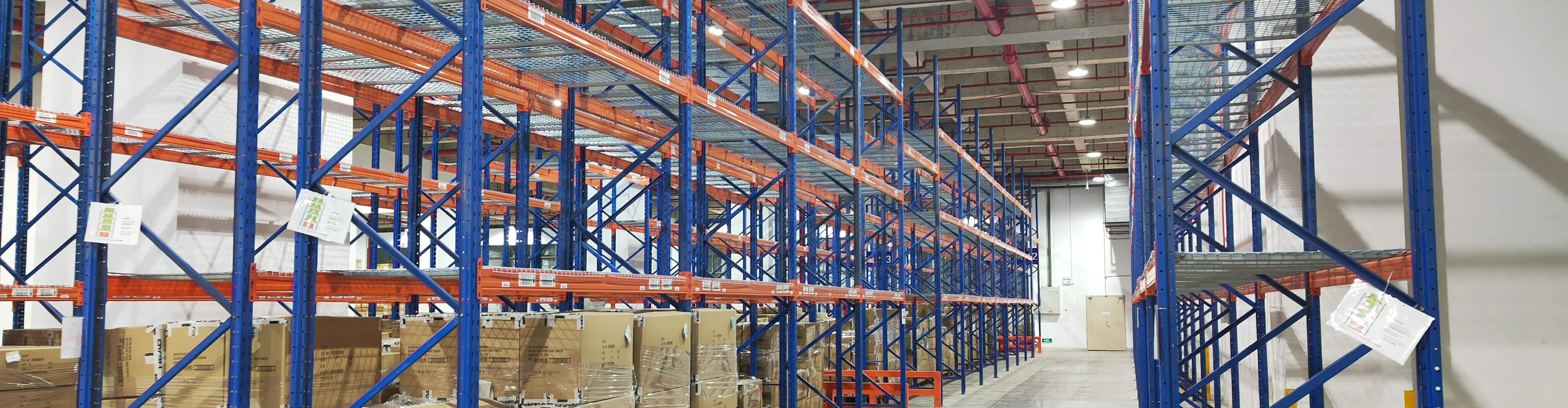
toring long and heavy materials has always been a major challenge in industrial warehouses, and this is exactly where Custom Cantilever Racking becomes essential. Traditional pallet racks were never designed for items such as pipes, aluminum profiles, timber planks, steel bars, or sheet goods. These materials tend to roll, sag, damage shelves, and take up valuable floor space. Worse still, they create handling difficulties that make forklift operators uncomfortable when working in tight aisles. By contrast, Custom Cantilever Racking provides a purpose-built storage solution that keeps long, irregular, and oversized materials stable, accessible, and safely organized.
This case comes from a manufacturing facility that had been wrestling with these exact problems for years. Their long materials were stacked directly on the floor, mixed together, and constantly in the way. The warehouse manager finally decided it was time for a proper storage system, so they approached us with a clear request:
“We need a safe, heavy-duty cantilever racking setup built exactly for our materials—not a standard size, not a guess—something that actually fits our warehouse.”
Below is the complete breakdown of how we designed a custom cantilever racking system based on their operation, load requirements, and layout constraints.
What Exactly Is Cantilever Racking, and Why Do Warehouses Use It?
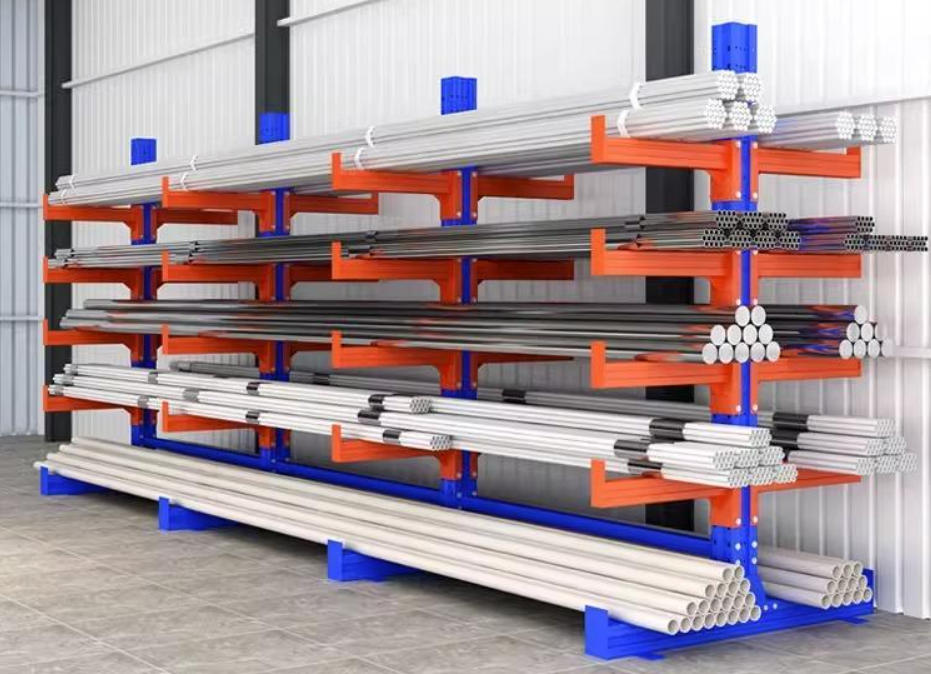
Cantilever racking is specifically designed for long, bulky, or irregular items—basically anything that refuses to sit neatly on a pallet. The structure is open on the front, giving forklifts full access from either direction. That alone solves half the safety concerns in a warehouse full of long items.
There are two common types:
- Single-sided cantilever racking: placed against a wall to save aisle space
- Double-sided cantilever racking: allows storage on both sides, doubling capacity
Each arm usually carries 1–2 tons, depending on the steel grade and design. Arm height adjustments are done in 100 mm increments, which is extremely useful when your materials vary in diameter or length.
In this customer’s case, they handled aluminum profiles, steel tubes, and several long products that came in different batches every month. Their existing method—floor stacking—was not only inefficient but also dangerous. Forklifts had a hard time approaching the pile, and workers had to drag materials by hand just to find the correct size.
Cantilever racking was the obvious solution.
How the Structure Works: Stable, Heavy-Duty, Built for Daily Warehouse Abuse
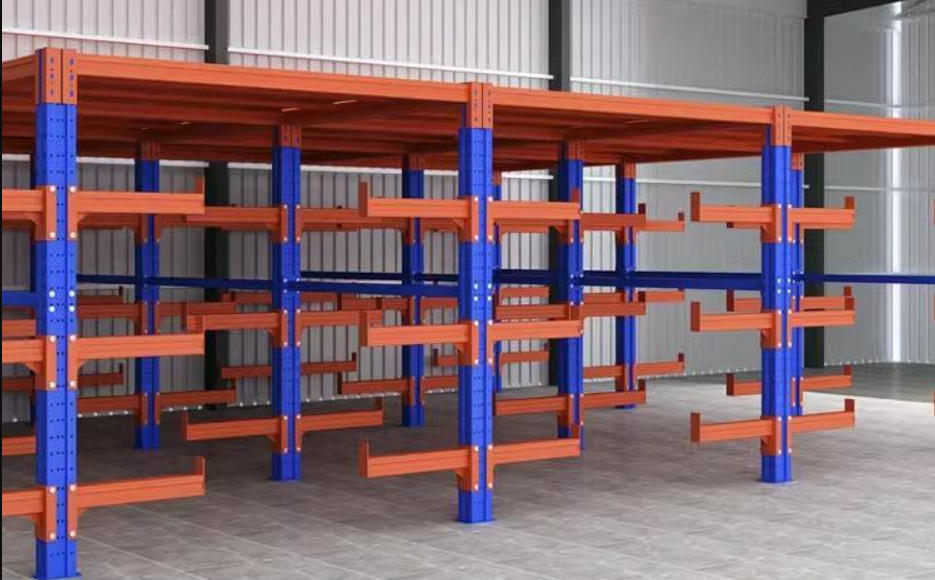
A cantilever rack is essentially made up of uprights, arms, a strong base, and back tie bracing. But when you’re dealing with real warehouses—not catalog drawings—you must consider how forklifts move, how materials shift, and how the floor reacts to heavy loading.
For this project, we used:
● H-beam base with welded anchor plates
H-beams were chosen because the customer required higher load capacity per level. The beams were cut, drilled, and welded according to national steel standards. Anchor holes were added to ensure the entire structure could be fixed firmly to the ground.
● Uprights reinforced with back ties
These back ties absorb sideways force, which is important because long materials are often uneven, and forklifts don’t always drive perfectly straight.
● Cantilever arms with 1,000 kg loading per level
These arms were built thicker than standard to avoid long-term bending. Forklifts bumping into arms is a daily reality—so we design with that in mind.
● 100 mm vertical adjustment
Demand changes. Materials change. A flexible system prevents future headaches.
The result is a racking system rugged enough to survive years of daily operations, not just look good on paper.
Customer Requirements and Our Custom Design
The customer provided specific data:
- Material lengths: mostly 4–6 meters
- Mixed categories that required separated storage
- Heavy weight per batch
- Limited warehouse space
- Need for smooth forklift operation
- Clear demand for color matching with existing fixtures
After evaluating the on-site layout and safety factors, we delivered the following configuration:
- Dimensions: L1000 × D1400 × H2000 mm
- Quantity: 3 complete sets
- Structure: 3+1 levels
- Load: 1000 kg per level
- Adjustment: 100 mm step adjustment
- Colors: Blue uprights, orange arms
This wasn’t a “template solution.”
It was designed to the customer’s actual load data and material size. If the arms are too short, the pipes fall. If the uprights are too light, they bend. If the base isn’t secured, the whole structure risks tilting. Every millimeter matters when you’re storing heavy, long materials.
Real Results After Installation: Space Doubled, Safety Improved
Once the cantilever racks were installed, the transformation was immediate:
● Space utilization increased dramatically
What used to occupy most of the floor now stood in organized vertical layers.
● Forklift access became smooth and predictable
Drivers no longer hesitated when approaching materials. Aisles became cleaner and safer.
● No more random piles of aluminum profiles
Everything had a dedicated position, which improved order picking and inventory accuracy.
● Safety risks dropped significantly
Cantilever arms held the weight securely. Workers no longer lifted long materials by hand or dug through piles.
● Warehouse management became more disciplined
The customer even implemented a color-coded classification method after seeing the system’s effect.
Final Thoughts: Good Racking Starts With Good Data
A cantilever racking system is not something you “just buy.”
It must be designed based on real materials, real weight, and real warehouse movement.
For this customer, we built a custom storage solution that solved long-standing problems:
- chaotic storage
- wasted floor space
- inconsistent inventory
- forklift operating hazards
- poor load distribution
If your warehouse also handles long items such as aluminum profiles, pipes, boards, steel bars, or other irregular goods, a properly engineered cantilever racking system can change your entire operation.
We offer:
- on-site measurement
- load analysis
- warehouse layout planning
- custom fabrication
- installation and after-service
A well-built racking system doesn’t just store goods—it improves efficiency, reduces accidents, and keeps your warehouse running smoothly for years.