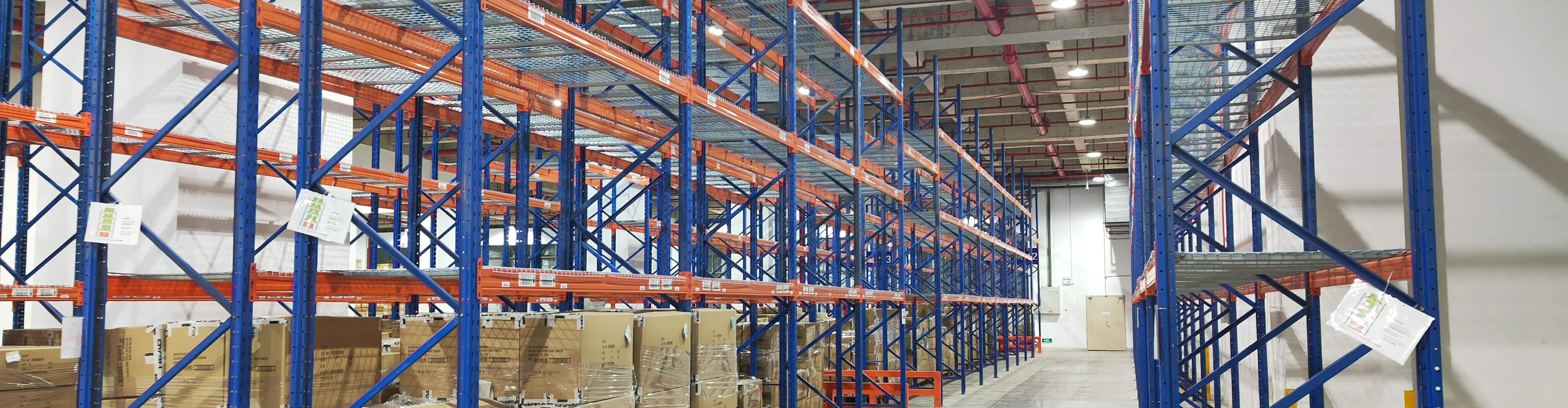
Heavy duty industrial pallet racking helps warehouses store large pallet loads safely, use vertical space more effectively, and keep inventory accessible for forklift handling. Its main benefits are higher storage capacity, better stock organization, faster pallet movement, and a structure that can support demanding industrial operations when it is correctly specified, installed, and maintained.

For many warehouses, heavy duty industrial pallet racking is the standard choice when goods are stored on pallets and need direct access. It is widely used in manufacturing, distribution, third-party logistics, wholesale storage, and spare parts operations because it balances load capacity, operational flexibility, and relatively straightforward access to each pallet position.
That said, the benefits depend on good planning. Beam levels, bay width, aisle layout, forklift type, pallet size, ceiling height, floor condition, and load consistency all affect whether the system performs well in daily use. A heavy duty setup can solve space and handling problems, but only if it matches the actual warehouse workflow.
Why heavy duty industrial pallet racking is widely used
Heavy duty industrial pallet racking is designed for storing palletized goods in a structured steel framework of uprights, beams, and accessories. In practical terms, it gives operators a way to stack inventory vertically while keeping each load in a defined location.
The reason it is so common is simple: many warehouses need to store heavy or bulky pallet loads without losing forklift access. Floor stacking may seem cheaper at first, but it often reduces visibility, limits selectivity, increases handling time, and wastes vertical cube. Heavy duty industrial pallet racking addresses those issues by turning unused height into organized storage capacity.
It is especially useful where businesses handle regular inbound and outbound pallet movement, carry multiple SKUs, or need a more disciplined storage layout than block stacking can provide.
Key benefits of heavy duty industrial pallet racking
1. Better use of vertical warehouse space
One of the biggest benefits of heavy duty industrial pallet racking is improved use of building height. Many warehouses run out of floor space long before they run out of cubic space. Racking allows that vertical volume to be used in a controlled way.
Instead of spreading pallets across the floor, loads can be stored across multiple beam levels. This can delay or reduce the need for warehouse expansion, off-site storage, or inefficient overflow areas. In higher-rent industrial buildings, making better use of available height can have a direct effect on storage economics.
However, vertical storage only works if lift equipment, clearances, sprinkler considerations, and pallet stability are properly considered during planning.
2. Direct access to pallet locations
A major operational advantage of heavy duty industrial pallet racking is selectivity. In a conventional selective layout, each pallet position can usually be accessed directly without moving other loads first. That matters in warehouses with mixed inventory, frequent replenishment, or customer orders that require fast retrieval.
Direct access supports:
- Faster pallet put-away and retrieval
- Better SKU visibility
- Reduced handling duplication
- Improved stock rotation control
- Less disruption during order preparation
For businesses carrying many product lines, this is often more valuable than maximum density alone. A denser system is not always the better system if it slows down access to the pallets that move every day.
3. Higher storage capacity than floor stacking
Heavy duty industrial pallet racking increases the number of pallets that can be stored within the same footprint compared with basic floor storage. By creating multiple storage levels and more disciplined lane organization, the warehouse can hold more inventory in a predictable layout.
This can be helpful for operations that need reserve stock, seasonal buffers, production materials, or finished goods staging. It also reduces the common problem of scattered pallet storage in temporary aisles or loading areas, which can interfere with traffic flow and safety.
The actual capacity gain depends on aisle width, rack height, pallet dimensions, and whether the design prioritizes selectivity or density.
4. Improved warehouse organization
Well-planned heavy duty industrial pallet racking makes stock control easier. Each bay and beam level can be allocated to a product family, SKU group, batch, or operational zone. This creates a more disciplined storage map and reduces the chance of random pallet placement.
Better organization supports:
- Clear location labeling
- More accurate inventory checks
- Faster staff training
- Cleaner replenishment routines
- Less time spent searching for stock
In practice, organization is one of the most overlooked benefits. Many warehouses do not have a pure space problem; they have a layout and control problem. Heavy duty industrial pallet racking can help solve both when paired with sensible slotting and traffic planning.
5. Strong load support for demanding inventory
As the name suggests, heavy duty industrial pallet racking is intended for more demanding load requirements than light shelving or lighter-duty storage systems. It is commonly used for palletized raw materials, cartons on pallets, bagged goods, drums on suitable supports, industrial components, and other substantial unit loads.
This does not mean every system suits every load. Pallet condition, load overhang, weight distribution, and beam span all matter. A warehouse storing uniformly loaded standard pallets has a different requirement from one storing mixed pallets with irregular dimensions or unstable packaging.
The benefit is not just strength. It is the ability to build a storage system around realistic industrial loading conditions rather than forcing heavy pallets into a layout meant for lighter applications.
6. Faster forklift workflow
When aisles, rack orientation, and pallet presentation are properly designed, heavy duty industrial pallet racking can improve travel efficiency for forklift operators. Operators can move through designated aisles, identify locations quickly, and handle pallets with fewer improvised moves.
This supports smoother workflow in receiving, reserve storage, replenishment, and dispatch areas. It can also reduce congestion caused by floor-stacked pallets and temporary storage in travel routes.
Operationally, the benefit comes from layout discipline. If aisle widths are too narrow for the equipment, beam levels are set at awkward heights, or pallets are inconsistent, the workflow benefit drops quickly. Good racking does not compensate for poor warehouse planning.
7. Scalability for future growth
Another benefit of heavy duty industrial pallet racking is expansion potential. Many businesses install a system in phases, adding bays, beam levels, row spacers, protection accessories, or additional aisles as stock volume changes.
This makes racking more flexible than some fixed storage approaches. If product mix changes, beam levels can often be adjusted to suit different pallet heights. If throughput increases, the layout can sometimes be reworked to improve flow.
Even so, expansion is easier when it is considered at the start. Warehouses that fill every available square meter with no allowance for traffic, staging, or future reconfiguration often create operational bottlenecks later.
8. Better separation of storage and working areas
Heavy duty industrial pallet racking helps define where inventory belongs and where people and equipment should move. This separation improves housekeeping and makes it easier to keep loading zones, picking faces, walkways, and marshalling areas clear.
In busy warehouses, this matters because disorder tends to spread. Once pallets begin to sit outside defined storage positions, aisles narrow, visibility drops, and forklift movements become less predictable. A structured racking layout supports cleaner warehouse discipline.
9. Supports inventory control and stock rotation
Heavy duty industrial pallet racking can also support more reliable stock rotation, especially in selective systems where each pallet location is visible and accessible. This is useful for operations managing batch control, production dates, replenishment priorities, or customer-specific stock allocation.
The racking itself does not create inventory accuracy, but it gives the warehouse a physical framework that makes control easier. Clear locations and easier access reduce the chance that older pallets become trapped behind newer ones, a common problem with less selective storage methods.
Operational benefits beyond storage capacity
When buyers evaluate heavy duty industrial pallet racking, they often focus first on how many pallets the system can hold. Capacity matters, but day-to-day operational value is just as important.
A good racking layout can improve:
- Travel paths for forklift operators
- Replenishment timing
- Stock visibility for cycle counts
- Separation of fast-moving and slow-moving items
- Housekeeping standards
- Damage awareness and inspection access
These practical gains affect labor efficiency and warehouse control. In many facilities, the real return comes from smoother handling and fewer avoidable disruptions, not simply from fitting more pallets into the building.
When heavy duty industrial pallet racking is a good fit
Heavy duty industrial pallet racking is usually a strong option when a warehouse stores palletized goods, needs regular forklift access, and wants a clear balance between accessibility and capacity. It is commonly a good fit where:
- There are many SKUs or changing stock lines
- Each pallet may need to be accessed individually
- The business wants to use vertical height efficiently
- Inventory is too heavy or bulky for shelving systems
- Operations need organized reserve storage near picking or dispatch zones
- Future layout adjustment may be necessary
It is often chosen for general-purpose pallet storage because it is versatile and relatively straightforward to integrate into common warehouse workflows.
Limitations and trade-offs to consider
Heavy duty industrial pallet racking is not automatically the right answer for every operation. Its benefits must be weighed against layout and workflow requirements.
It may not deliver the highest storage density
If density is the main objective and SKU count is low, other systems such as drive-in racking or high-density solutions may store more pallets in the same area. Selective heavy duty industrial pallet racking usually trades some density for better access.
Forklift aisle requirements affect footprint
Standard pallet racking layouts need aisles wide enough for the handling equipment. In buildings with limited floor area, aisle space can become a major planning factor. The rack itself may be efficient, but the full system footprint includes access space.
Load discipline is essential
The system works best when pallet sizes, pallet condition, and load weights are reasonably controlled. Mixed or damaged pallets create handling risk and can reduce storage efficiency. Warehouses with inconsistent unit loads may need more protective accessories or different beam spacing.
Damage risk must be managed
In active forklift environments, upright impact and beam damage are real concerns. Heavy duty industrial pallet racking is durable, but it still requires regular inspection, protection measures, and prompt response when damage occurs.
What to check before investing in heavy duty industrial pallet racking
Before choosing a system, warehouse planners and buyers should review the practical conditions that affect performance:
- Pallet type and dimensions: Are pallets uniform, oversized, or inconsistent?
- Maximum pallet weight: What is the heaviest realistic load per position and per bay?
- Forklift type: What turning radius, lift height, and aisle width are required?
- Clear building height: How much usable vertical space is available after allowing for clearances?
- Floor condition: Can the floor support the intended point loads and anchoring arrangement?
- SKU profile: Is the operation handling many SKUs or a small number of repeat lines?
- Stock rotation: Is direct access important for FIFO-style control or batch management?
- Growth expectations: Will more bays, higher levels, or layout changes be needed later?
These questions help determine not only whether heavy duty industrial pallet racking is suitable, but also what configuration makes sense.
Maintenance and safety benefits depend on proper management
Heavy duty industrial pallet racking supports safer and more controlled storage than ad hoc floor stacking, but only if the system is used correctly. The benefits are closely tied to routine management.
Good practice includes:
- Checking uprights and beams for impact damage
- Verifying anchors and floor fixings remain secure
- Keeping load notices and location labels clear
- Ensuring pallets are in sound condition before storage
- Training operators on correct pallet placement
- Keeping aisles free from loose materials and overflow stock
- Reviewing overloading risks when inventory changes
A neglected rack system loses many of its operational benefits. Storage efficiency, accessibility, and safety all depend on consistent use and inspection.
Common mistakes that reduce the benefits
Some warehouses install heavy duty industrial pallet racking but do not get the expected results because of avoidable planning errors. Common examples include:
- Choosing a layout based only on pallet count, not workflow
- Ignoring forklift turning and lifting requirements
- Using inconsistent or damaged pallets
- Setting beam levels without considering actual load heights
- Leaving no room for staging, replenishment, or future growth
- Failing to install column protection in impact-prone areas
- Overlooking inspection routines after commissioning
The lesson is straightforward: the system should be designed around real operations, not just a drawing or a target capacity figure.
FAQ
What is the main benefit of heavy duty industrial pallet racking?
The main benefit of heavy duty industrial pallet racking is that it increases pallet storage capacity while keeping loads organized and accessible for forklift handling.
Is heavy duty industrial pallet racking suitable for all warehouses?
No. It is most suitable for palletized storage where direct access, vertical space use, and organized handling are important. It may be less suitable if the main goal is maximum density for a small number of SKUs.
Can heavy duty industrial pallet racking improve safety?
It can improve storage discipline and reduce the problems associated with uncontrolled floor stacking, but safety depends on correct design, installation, operator training, pallet quality, and regular inspections.
What affects the performance of a pallet racking system most?
Key factors include pallet size and weight, aisle width, forklift type, ceiling height, floor condition, SKU profile, and how consistently the warehouse follows loading and inspection procedures.
Conclusion
The benefits of heavy duty industrial pallet racking are clear: better use of vertical space, stronger support for palletized goods, improved stock organization, direct forklift access, and a more controlled warehouse layout. For many operations, it is a practical foundation for efficient pallet storage rather than just a way to add more bays.
The real value of heavy duty industrial pallet racking comes from matching the system to the building, the inventory, and the handling method. Warehouses that plan around load characteristics, aisle access, future growth, and inspection routines are more likely to gain long-term operational benefits from the investment.