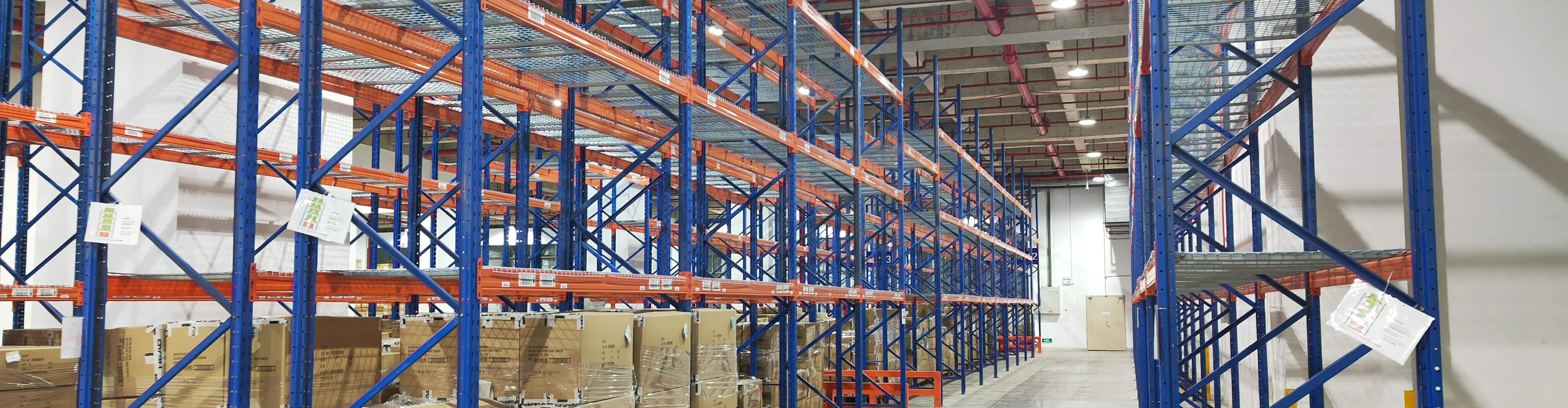
Pallet racking is available in several main types, each designed for a different balance of accessibility, storage density, stock rotation, and forklift handling. The most common options include selective pallet racking, double deep racking, drive-in and drive-through racking, push-back racking, pallet flow racking, cantilever racking for long loads, and mobile racking. Some warehouses also use very narrow aisle systems or shuttle-based high-density solutions where storage volume and space efficiency are critical.
The right choice depends less on what is most popular and more on how your warehouse actually operates. Pallet size consistency, SKU count, stock rotation method, forklift type, aisle width, ceiling height, floor condition, and replenishment workflow all affect which pallet racking system will work well in practice.
Why there are different types of pallet racking
No single pallet racking system suits every warehouse. A business storing many SKUs with frequent picking usually needs direct access to every pallet. A site handling large volumes of the same product may accept reduced selectivity in exchange for higher storage density. Cold stores, production facilities, distribution centers, and spare parts warehouses often have very different priorities.
That is why pallet racking systems are typically chosen around a few practical questions:
- Do you need direct access to every pallet position?
- Is storage density more important than selectivity?
- Are you operating FIFO or LIFO stock rotation?
- What forklift trucks are used, and how much aisle space do they need?
- Are the pallets uniform in size, weight, and condition?
- Will the system need to expand later?
Understanding the main types makes it much easier to narrow down suitable options before moving into detailed layout and load planning.
Main types of pallet racking
1. Selective pallet racking
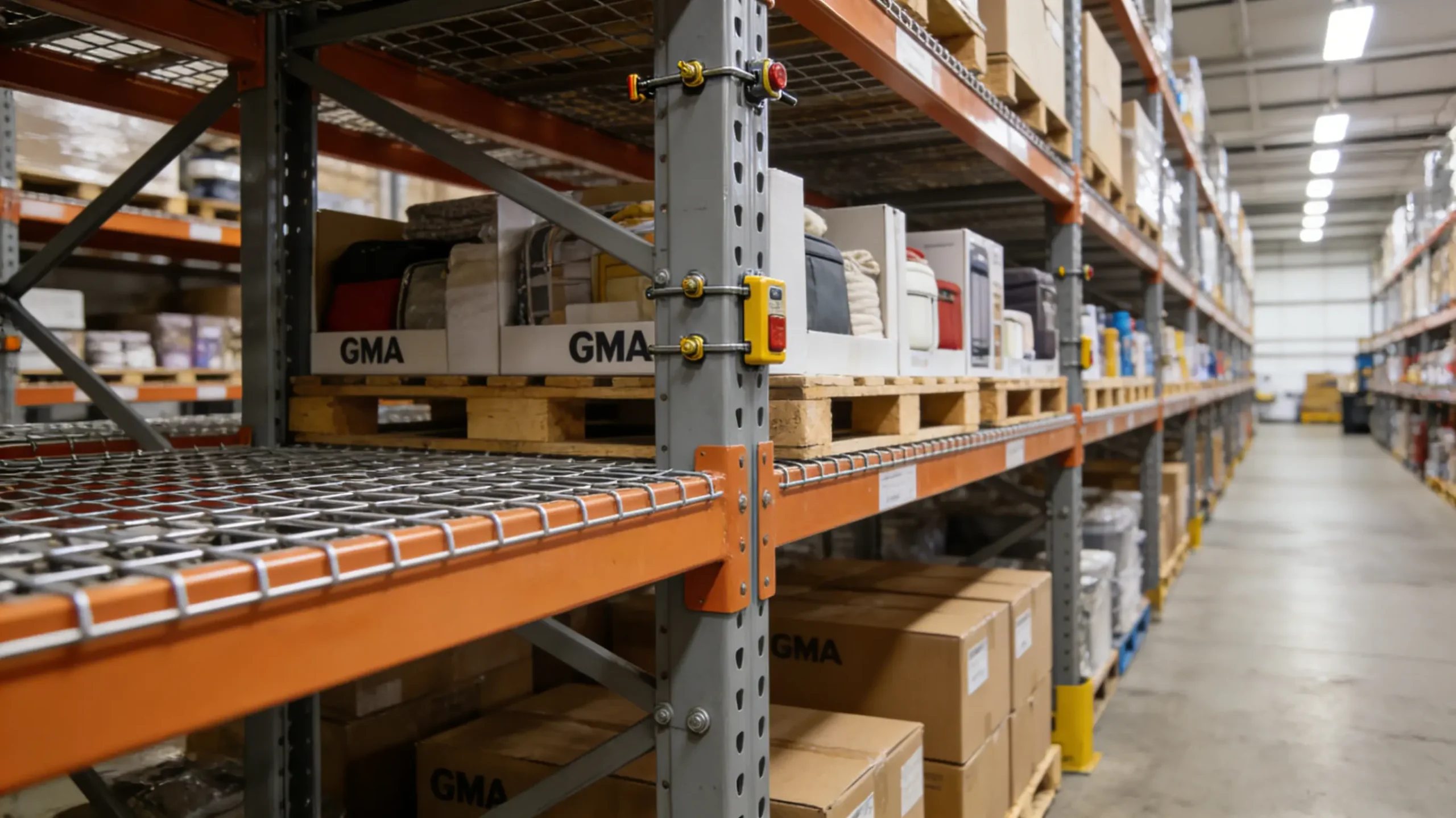
Selective pallet racking is the most widely used pallet racking system because it gives direct access to every pallet. Standard uprights and beams create rows of bays, with aisles between them for forklift access. It is commonly used in general warehousing, third-party logistics, wholesale distribution, and facilities with a broad SKU range.
This system is usually the easiest to understand, install, inspect, and adapt. It works well where stock lines change regularly or where operators need fast access to individual pallets without moving other loads first.
Typical advantages:
- Direct access to each pallet
- Suitable for many SKU types
- Flexible for changing inventory profiles
- Simpler visual inspection and maintenance
- Compatible with many picking and replenishment operations
Typical limitations:
- Lower storage density than high-density systems
- Requires more aisle space
- May not maximize cubic storage in expensive floor space
Selective pallet racking is often the practical starting point when a warehouse needs flexibility more than maximum density.
2. Double deep pallet racking
Double deep racking is similar to selective pallet racking, but pallets are stored two deep instead of one. This reduces the number of aisles and increases storage density. However, the rear pallet position is blocked by the front pallet, so direct access to every pallet is lost.
It is generally suited to warehouses storing larger quantities of the same SKU across multiple pallet positions. Operators usually need reach trucks or specialist handling equipment capable of placing and retrieving pallets from the second position.
Best suited for:
- Medium to high pallet volumes
- Lower SKU variety than a fully selective layout
- Operations that can tolerate some access trade-offs
Points to watch:
- Requires suitable forklift equipment
- Can create stock rotation challenges
- Less efficient if many rear pallet positions remain partially used
3. Drive-in and drive-through pallet racking
Drive-in and drive-through pallet racking are high-density systems where forklifts enter the racking structure to place pallets on support rails. In drive-in racking, pallets are loaded and retrieved from the same side, which usually supports LIFO stock rotation. In drive-through racking, pallets can be loaded from one side and retrieved from the other, making FIFO operation possible.
These systems are often used for large quantities of similar palletized goods, especially where storage density matters more than immediate access to every pallet. They are common in cold storage, buffer storage, and batch-based inventory environments.
Advantages:
- High storage density
- Good use of cube space
- Suitable for large runs of the same product
Limitations and operational concerns:
- Reduced selectivity
- Higher risk of impact damage because forklifts enter the structure
- Requires disciplined pallet quality and careful operator training
- Can be slower if product variety is high
Drive-in systems can work well, but they demand realistic assessment of pallet consistency, truck handling quality, and inspection discipline. If pallet sizes vary or operators regularly rush maneuvers, maintenance and damage issues can increase.
4. Push-back pallet racking
Push-back pallet racking stores pallets on inclined carts or rails. When a new pallet is loaded, it pushes the previous pallet back. When a pallet is removed, the remaining pallets roll forward into the picking position. This creates a high-density LIFO storage method without requiring forklifts to drive into the rack.
Push-back systems are useful when a warehouse needs more density than selective pallet racking but wants easier operation than drive-in racking. They are often chosen for buffer stock, medium-SKU storage, and operations with multiple pallets per SKU.
Advantages:
- Higher density than selective racking
- No truck entry into the lane structure
- Faster loading and unloading than some deep-lane alternatives
Limitations:
- LIFO only
- Not ideal for very high SKU fragmentation
- System performance depends on proper pallet condition and lane setup
This type of pallet racking is often a good compromise where storage density is important but direct truck entry into lanes is undesirable.
5. Pallet flow racking
Pallet flow racking, also called gravity flow racking, uses inclined roller lanes so pallets move from the loading side to the picking side by gravity. This supports FIFO stock rotation, which makes it useful for dated products, food and beverage stock, pharmaceuticals, and other inventory where batch control matters.
Because loading and unloading occur from opposite faces of the rack, pallet flow systems can improve replenishment discipline and reduce interference between put-away and picking traffic.
Typical benefits:
- FIFO stock rotation
- High storage density
- Separation of loading and picking activity
- Useful for high-throughput pallet lanes
Planning considerations:
- Requires consistent pallet quality and dimensions
- Usually higher system complexity than standard selective racking
- Not always economical for low-volume or highly mixed SKU storage
If pallet quality is poor, flow performance can suffer. In practice, this system works best where pallets are reasonably uniform and stock movement justifies the investment.
6. Very narrow aisle pallet racking
Very narrow aisle, or VNA, pallet racking is not a separate rack structure in the same way as drive-in or push-back, but rather a layout approach using tighter aisles and specialist trucks. It is designed to increase storage capacity by reducing aisle width while still keeping a high degree of selectivity.
VNA can be effective in buildings with good clear height and a need to store many pallet positions within a limited footprint. It is common in distribution operations where space is expensive and selective access remains important.
Advantages:
- High selectivity
- Better space use than conventional wide-aisle layouts
- Good for high-bay warehouses
Limitations:
- Requires specialist trucks and guidance systems in many cases
- Floor flatness and condition become more critical
- Operational flexibility may be lower if truck availability is limited
VNA can be attractive on paper, but equipment dependency and floor tolerances should be assessed early, not after the layout is fixed.
7. Mobile pallet racking
Mobile pallet racking places racking rows on powered mobile bases, allowing aisles to open only where needed. This minimizes the number of permanent aisles and can significantly improve storage density while retaining access to pallets.
It is often considered where building footprint is constrained or where chilled and frozen storage space is costly. By reducing unused aisle space, mobile systems can increase pallet capacity within the same area.
Suitable for:
- Cold stores
- Archive-style pallet storage with lower access frequency
- Warehouses where space is more constrained than throughput
Trade-offs:
- Higher system complexity
- Access speed may be slower than static selective layouts
- Requires reliable controls, maintenance planning, and operating discipline
Mobile pallet racking is usually less attractive in very fast-moving operations where multiple trucks need simultaneous access to many aisles.
8. Shuttle and semi-automated deep-lane systems
Some warehouses use shuttle-based pallet racking for high-density storage. In these systems, a shuttle device moves pallets within deep lanes, reducing the need for forklifts to enter the rack. These systems are often considered for high-volume operations with repetitive pallet handling patterns.
They can offer strong space utilization and operational efficiency in the right environment, but they are not automatically the right answer for every warehouse. Equipment management, battery charging, operator training, service support, and inventory discipline all matter.
Generally suited to:
- High-volume pallet storage
- Deeper lane configurations
- Operations with relatively stable pallet formats and throughput patterns
Less suitable where:
- SKU count is very high and fragmented
- Budget sensitivity is high
- Operational teams prefer simpler mechanical systems
9. Cantilever racking for non-standard loads
Cantilever racking is not standard pallet racking for conventional pallet loads, but it is often considered alongside it when a warehouse stores long, bulky, or awkward items such as timber, pipe, bar stock, or sheet materials. Instead of front upright obstruction, loads sit on projecting arms.
If your product is not truly palletized, cantilever may be more appropriate than trying to force non-standard loads into beam racking. This is a common planning mistake in mixed-use warehouses.
How to choose the right pallet racking type
When comparing pallet racking options, the practical decision usually comes down to five factors: selectivity, density, rotation, handling method, and building constraints.
1. SKU profile and access requirements
If you store many SKUs and need access to individual pallets at any time, selective pallet racking or VNA layouts are usually more suitable. If you store fewer SKUs in larger quantities, deep-lane or high-density systems become more practical.
2. FIFO or LIFO stock rotation
For strict FIFO handling, pallet flow and some drive-through layouts are often considered. For LIFO environments, push-back and drive-in systems may be acceptable. If stock rotation discipline matters for shelf life or batch control, this should be settled before layout design starts.
3. Forklift type and aisle width
The rack cannot be chosen in isolation from the handling equipment. Reach trucks, counterbalance trucks, VNA trucks, and shuttle support equipment all have different aisle and operating requirements. A layout that looks efficient on a plan can become difficult in daily use if turning circles, lift heights, or visibility are not considered properly.
4. Pallet quality and load consistency
High-density systems generally demand more consistency. Damaged pallets, uneven loads, and variable pallet dimensions can create handling problems, especially in push-back, flow, drive-in, and shuttle-based systems. If pallet quality is inconsistent, simpler selective pallet racking may be more forgiving.
5. Building and floor constraints
Clear height, column spacing, slab condition, door positions, sprinkler arrangement, and traffic flow all affect system choice. For example, a high-bay building may support VNA or tall selective layouts effectively, while a low-clearance site may gain more from denser lane storage. Floor condition also matters where specialist trucks or mobile bases are involved.
Common mistakes when selecting pallet racking
- Choosing for maximum pallet count without considering picking efficiency
- Ignoring forklift maneuvering realities and aisle clearance
- Using high-density systems for highly fragmented SKU storage
- Overlooking pallet condition and load stability
- Failing to plan for future expansion or stock profile changes
- Underestimating inspection and repair needs in impact-prone systems
A system can look efficient in terms of storage density while creating slower replenishment, more product handling, or higher damage exposure. Good selection balances space use with real operating conditions.
Inspection, safety, and maintenance considerations
All pallet racking types need regular inspection and safe operation, but some systems are more exposed to damage than others. Drive-in racking, for example, often sees more impact risk because trucks enter the lanes. Tall systems and narrow aisles may increase the importance of floor condition, truck guidance, and operator discipline.
Routine checks should typically include visible upright damage, beam deflection, missing safety locks, anchor condition, overloaded levels, and signs of pallet misuse. Any change in pallet type, handling equipment, or stored load should be reviewed carefully rather than assumed to be compatible with the existing system.
It is also sensible to think ahead about replacement parts, access for repairs, and how maintenance can be carried out without disrupting the whole warehouse.
Which type of pallet racking is most common?
Selective pallet racking is the most common because it is flexible, widely understood, and suitable for many warehouse operations. That does not make it the right choice for every site. Warehouses with limited floor space or high volumes of the same product often move toward denser systems such as drive-in, push-back, pallet flow, or mobile pallet racking.
In practice, many facilities use more than one type. A warehouse might combine selective pallet racking for reserve stock and mixed SKUs, pallet flow for fast-moving FIFO lines, and cantilever for long materials. Mixed layouts are often more realistic than trying to make one system solve every storage problem.
FAQ
What is the difference between selective and drive-in pallet racking?
Selective pallet racking gives direct access to every pallet. Drive-in racking increases storage density by storing pallets deep in lanes, but access is reduced because pallets are handled from the lane face and forklifts enter the structure.
Which pallet racking type is best for FIFO stock rotation?
Pallet flow racking is one of the most common choices for FIFO operation. Drive-through layouts may also support FIFO in some applications, depending on the handling method and lane design.
Is high-density pallet racking always better?
No. High-density systems save space, but they can reduce selectivity, complicate stock rotation, and demand more consistent pallets and disciplined forklift operation. They work best when inventory profile and workflow support them.
Can one warehouse use different pallet racking systems?
Yes. Many warehouses use a combination of pallet racking types to match different products, throughput levels, and handling methods within the same facility.
Conclusion
The main types of pallet racking include selective, double deep, drive-in, drive-through, push-back, pallet flow, VNA, mobile, shuttle-based systems, and cantilever for non-standard loads. The right choice depends on how your warehouse needs to balance accessibility, density, stock rotation, equipment compatibility, and operational risk.
If you are evaluating pallet racking for a new installation or warehouse redesign, start with the realities of your stock profile and handling workflow rather than the maximum pallet count alone. A practical system is one that stores product safely, supports daily operations efficiently, and remains manageable to inspect, maintain, and adapt as the business changes.