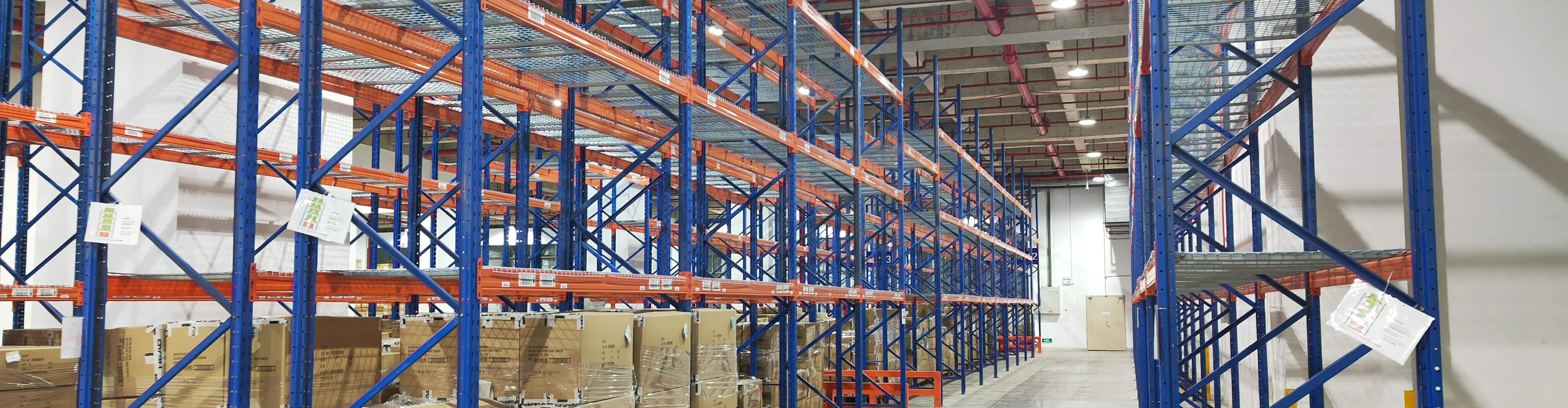
The main types of Pallet Racking Systems used in commercial warehouses are selective racking, double-deep racking, very narrow aisle racking, drive-in racking, drive-through racking, push-back racking, pallet flow racking, mobile racking, and, in some projects, shuttle-based high-density systems. Each option solves a different storage problem. Some prioritize direct pallet access, some increase storage density, and some are designed around fast stock rotation or limited floor space.
For most warehouse operators, the right choice is not about finding a universally superior system. It is about matching the rack layout to pallet dimensions, SKU profile, forklift type, aisle width, ceiling height, pick frequency, throughput targets, and expansion plans. A system that performs well in a full-pallet distribution center may be inefficient in a mixed warehouse with many SKUs and frequent replenishment.
This guide explains the main types of Pallet Racking Systems, how they work, where they fit, and what buyers and planners should evaluate before making a decision.
Why understanding Pallet Racking Systems matters
Pallet Racking Systems affect more than storage capacity. They influence forklift travel time, picking speed, stock rotation discipline, damage risk, inspection access, and future flexibility. In practice, the wrong system often creates avoidable operating costs. A layout that looks efficient on paper can become difficult to manage once real pallets, actual forklifts, and daily workflow are involved.
Before reviewing the main rack types, it helps to keep four decision factors in mind:
- Selectivity: how easily each pallet location can be reached.
- Storage density: how much inventory can be stored in a given footprint.
- Stock rotation: whether the system supports FIFO or LIFO operation.
- Handling conditions: forklift access, pallet consistency, and operator discipline.
Main types of Pallet Racking Systems
1. Selective pallet racking
Selective racking is the most common of all Pallet Racking Systems. It gives direct access to every pallet position, usually with single-deep rows served by standard forklifts. This makes it easy to manage, easy to inspect, and suitable for warehouses that store many SKUs with varied turnover rates.
This system is often the default choice for general warehousing, third-party logistics, manufacturing stores, and facilities where order accuracy and flexibility matter more than maximum density. It works well when pallets need to be accessed individually without moving other loads first.
The trade-off is space efficiency. Because each row needs working aisles, selective racking uses more floor area than high-density alternatives. It is a strong fit for mixed inventory, but less efficient where the business stores large volumes of the same SKU.
2. Double-deep pallet racking
Double-deep racking is a variation of selective racking where pallets are stored two deep instead of one. It reduces the number of aisles and improves density compared with standard selective layouts. Warehouses often consider this option when they need more capacity but still want a relatively familiar rack structure.
The limitation is accessibility. The front pallet must usually be removed before the rear pallet can be reached, so stock rotation becomes more restrictive. Double-deep layouts also require suitable forklifts, typically with deeper reach capability, and they perform better when pallet sizes and load conditions are consistent.
Among Pallet Racking Systems, double-deep racking is useful when density needs are increasing but a full shift to drive-in or flow-based storage is not practical.
3. Very narrow aisle racking
Very narrow aisle, or VNA, racking is designed to increase storage capacity by reducing aisle width. The rack itself may resemble selective racking, but the operating model depends on specialized lift trucks or guided handling equipment that can work safely in tighter aisles.
This is a common solution in warehouses where floor space is limited but building height is available. VNA layouts can improve cube utilization while still maintaining direct access to pallets. For operations with high SKU counts and a need for individual pallet retrieval, it can be more practical than switching to a deep-lane system.
However, VNA is not simply a rack purchase. It is a warehouse system decision. Floor flatness, truck selection, guidance method, maintenance planning, and traffic flow all matter. If the floor condition is poor or the operation relies on mixed forklift traffic, VNA may create more operating complexity than expected.
4. Drive-in pallet racking
Drive-in racking is one of the higher-density Pallet Racking Systems. Forklifts enter the rack structure and place pallets on rails within deep lanes. Because there are fewer aisles, storage density is significantly higher than in selective layouts.
This system is typically used for large quantities of the same SKU or for products with lower selectivity requirements. Cold storage operators often consider drive-in racking because cubic space is expensive and dense storage can reduce the refrigerated footprint per pallet.
The downside is that selectivity is limited and operation is usually LIFO. It also places more importance on pallet condition, operator skill, and impact control. Since forklifts drive into the structure, the risk of upright or rail damage is higher than with open-face racks. It is less suitable for fragile loads, mixed-SKU storage, or operations that need frequent access to many individual pallet positions.
5. Drive-through pallet racking
Drive-through racking is similar to drive-in racking, but lanes can be loaded from one side and unloaded from the other. This makes FIFO stock rotation possible when the warehouse layout supports separate loading and picking faces.
For certain food, beverage, or date-sensitive inventory profiles, this can be a practical compromise between density and rotation control. The system still shares many of the same handling risks as drive-in racking, including forklift contact inside the lanes and heavier dependence on pallet consistency.
In real operations, drive-through layouts require disciplined traffic planning. Without good lane assignment and stock control, the theoretical FIFO benefit can be weakened by day-to-day handling shortcuts.
6. Push-back racking
Push-back racking stores pallets on nested carts or roller-supported carriers. When a new pallet is loaded, it pushes the previous pallet backward. When a pallet is removed, the next pallet rolls forward into position. This system usually operates on a LIFO basis.
Push-back is one of the more efficient Pallet Racking Systems for balancing density and accessibility. Forklifts do not need to enter the rack, which reduces structural impact compared with drive-in systems. It is often used where there are multiple pallets per SKU and a need for better lane access than deep-lane drive-in storage can provide.
Its limitations are important. It depends on good pallet quality, stable loads, and proper lane design. It is not ideal for damaged pallets, highly irregular load bases, or operations that require strict FIFO rotation. Maintenance access to moving components also deserves attention during planning.
7. Pallet flow racking
Pallet flow racking uses gravity rollers to move pallets from the loading side to the picking side. It is one of the most recognizable FIFO Pallet Racking Systems and is often selected for first-expiring inventory, high-throughput replenishment, or buffered staging between warehouse processes.
When designed properly, pallet flow can support efficient stock rotation and reduce travel time. It is useful in cold storage, food distribution, beverage handling, and production environments where continuous movement matters.
At the same time, pallet flow is more sensitive to layout accuracy, pallet quality, brake control, and lane maintenance than basic selective racking. If pallet dimensions vary too much or loads are unstable, flow performance can become inconsistent. Buyers should also evaluate how easy it will be to inspect rollers, separators, and speed-control components over time.
8. Mobile pallet racking
Mobile racking places rack rows on motorized bases so aisles open only where access is needed. This allows warehouses to reduce the number of fixed aisles and gain very high storage density without fully sacrificing pallet accessibility.
Among Pallet Racking Systems, mobile racking is often considered when floor area is costly and selectivity still matters. It can work well in cold rooms, archive-style pallet storage, or facilities where throughput is moderate but space utilization is critical.
The trade-off is operating speed and system dependence. Only one working aisle may be open in a given section at a time, so it is not ideal for fast, multi-truck environments with constant simultaneous access needs. The system also depends on mechanical and electrical reliability, which means maintenance planning is more important than with static racking.
9. Shuttle-based high-density racking
Some warehouses also use shuttle-assisted solutions as part of modern Pallet Racking Systems. In these layouts, a powered shuttle moves pallets within deep lanes while forklifts place and retrieve the shuttle itself. This approach can improve density and reduce direct forklift entry into the rack.
Shuttle systems are often considered for high-volume operations, cold storage, or facilities with repetitive pallet profiles. They can reduce some of the damage exposure seen in drive-in operations, but they introduce equipment management, battery control, and higher capital complexity. They are not always necessary for medium-scale warehouses with simpler inventory needs.
How to compare Pallet Racking Systems in practical terms
When comparing Pallet Racking Systems, warehouse teams should avoid looking only at storage capacity. A more useful comparison includes day-to-day operating impact:
- For high SKU variety: selective or VNA racking is usually easier to manage.
- For high-density storage of similar pallets: drive-in, push-back, shuttle, or mobile systems may be more suitable.
- For strict FIFO rotation: pallet flow or drive-through layouts often make more sense than LIFO systems.
- For standard forklifts and simpler training: selective racking is usually the lowest-friction option.
- For cold storage or expensive floor area: dense Pallet Racking Systems often justify closer review.
No system should be selected in isolation from the building and the handling method. Clear height, sprinkler design, floor condition, pallet overhang, beam spacing, and lift truck turning requirements can all affect what is realistically achievable.
Common mistakes when choosing pallet racking
- Choosing density over usability: a dense layout can slow operations if access becomes too restricted.
- Ignoring pallet quality: deep-lane and flow-based systems depend heavily on pallet consistency.
- Underestimating forklift requirements: some Pallet Racking Systems need specific truck types or higher operator skill.
- Planning only for current stock: future SKU growth and layout changes should be considered early.
- Overlooking inspection access: dense systems can make routine safety checks and maintenance more difficult.
What warehouse buyers should review before making a decision
Before choosing among Pallet Racking Systems, buyers should review a short list of operational facts:
- How many pallets per SKU are typically stored?
- Does the business need FIFO, LIFO, or mixed rotation?
- What forklifts are currently in use, and will new equipment be required?
- Is the warehouse limited more by floor area or by clear height?
- Are pallets standardized, or do dimensions and load quality vary?
- Will the operation grow, change product mix, or add picking activity later?
These questions usually narrow the options quickly. In many projects, the correct answer is not the most advanced system. It is the one that the warehouse can operate safely, inspect reliably, and adapt over time without creating unnecessary handling cost.
FAQ
Which type of pallet racking is most common?
Selective racking is the most common because it provides direct access to every pallet and works well for mixed inventory.
Which pallet racking system gives the highest storage density?
Drive-in, mobile, shuttle-based, and some flow or push-back layouts can offer high density, but the best choice depends on SKU mix, rotation needs, and forklift method.
Which pallet racking system is best for FIFO inventory?
Pallet flow racking is one of the strongest FIFO options. Drive-through racking can also support FIFO when the layout allows separate loading and unloading faces.
Are high-density systems harder to maintain?
They often require more discipline. Dense Pallet Racking Systems can limit access for inspection and may place more importance on pallet condition, lane integrity, and operator control.
Conclusion
The main types of Pallet Racking Systems serve different operational priorities. Selective and VNA layouts favor accessibility. Double-deep, push-back, and pallet flow systems balance density with structured access. Drive-in, drive-through, mobile, and shuttle-assisted solutions are used when storage density becomes a stronger priority than simple one-pallet access.
The most practical choice depends on how your warehouse actually runs: what you store, how often pallets move, what forklifts you use, how much space you have, and how tightly you need to control rotation. A sound racking decision should improve storage capacity without making handling slower, inspection harder, or future changes more difficult.